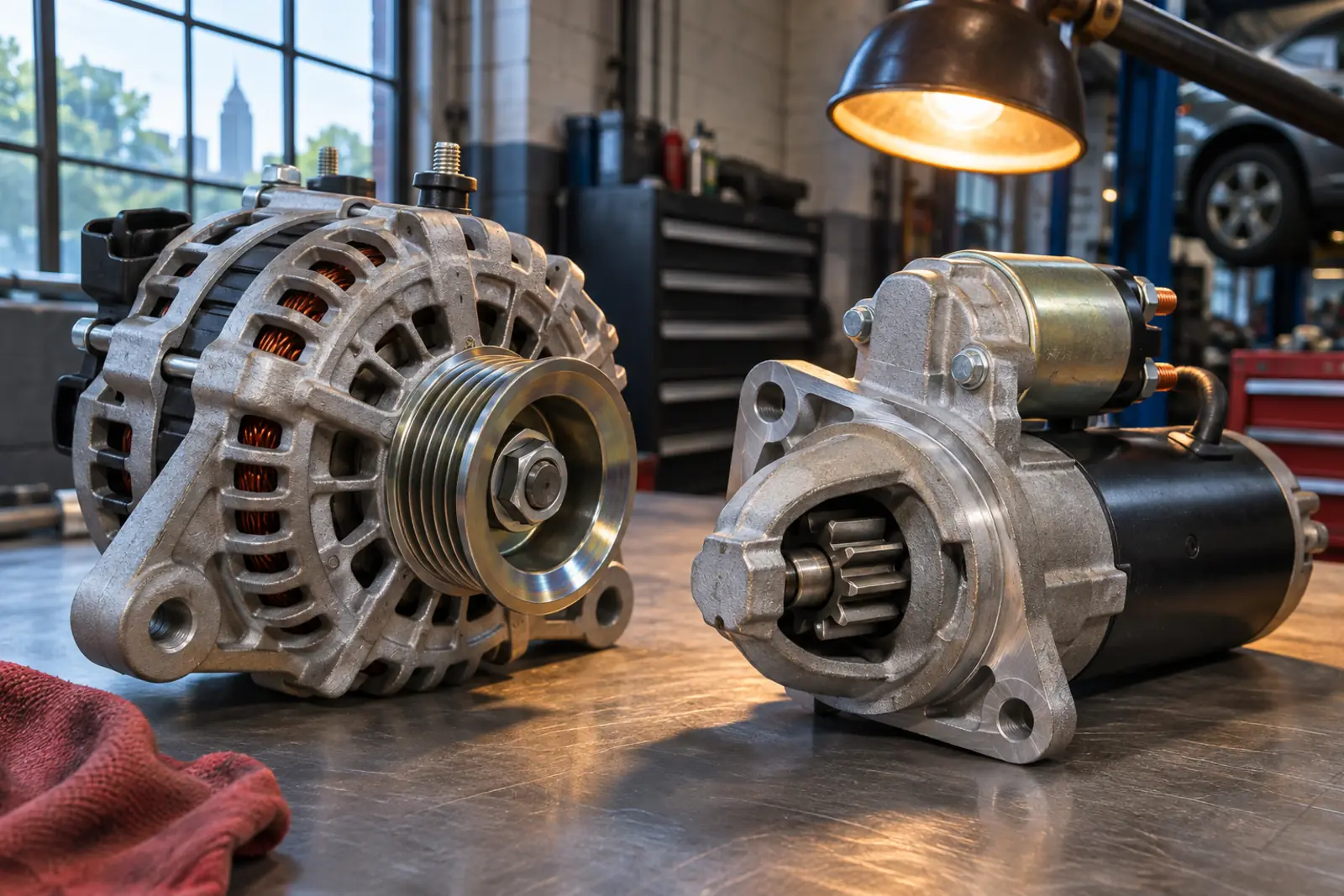
The quickest way to tell an alternator problem from a starter problem is to look at when the trouble happens. A bad starter shows up when you turn the key: a single click, grinding or nothing at all, while the dash lights stay bright. A failing alternator shows up while the car is running or over several days: dimming lights, a battery warning light, electrical glitches and a battery that keeps going flat. A weak battery can mimic both, so a proper test of the battery, the starter draw and the charging output is the reliable way to know before you buy parts.
What each part does
The starter is an electric motor that spins the engine to get it running. It draws a large current from the battery for a few seconds, then disengages. A solenoid on the starter works like a relay: it pushes the drive pinion into the engine's flywheel ring gear and closes the high-current contacts that feed the motor, and a spring pulls the pinion back once you release the key (Wikipedia, "Starter (engine)"). The alternator is driven by the engine's accessory belt and produces electricity while the engine runs, recharging the battery and powering the lights, fans, infotainment and engine computers. The battery sits between them: it supplies the starter and is refilled by the alternator.
Because the three depend on each other, one failure often looks like another. A dying alternator leaves the battery flat, which then makes the starter seem dead. A failing starter that drags can drain a healthy battery after a few attempts.
Alternator vs starter vs battery: which one is it?
Match the moment the problem appears. Trouble when you turn the key points to the starter, its solenoid or wiring, or a battery too weak to turn the engine. Trouble while driving, such as a battery light, dim lights or a stall, points to the alternator or its belt. A car that starts fine after a jump but will not restart later points to the alternator (not charging) or to a battery that can no longer hold a charge.
- Starter: bright dash lights and headlights, then a click, a grind or silence when you turn the key. A jump start usually does not help.
- Alternator: the car runs, then dies as the battery drains. A jump start gets you going, but the car stalls again within minutes or a few trips.
- Battery: slow cranking, rapid clicking and dim lights at the moment you try to start. A jump or a full charge fixes it, and it may or may not hold overnight.
The battery guide explains how battery age and Atlanta summer heat shorten battery life, so this page stays on telling the three parts apart.
Bad alternator symptoms
- A battery or charging warning light on the dash while driving.
- Headlights and dash lights that dim at idle and brighten when you rev the engine.
- Power windows, seat heaters, the radio or the infotainment screen acting slow, flickering or glitching.
- A whining or grinding noise from the front of the engine that rises with engine speed.
- A burning rubber or hot wire smell.
- A battery that is repeatedly flat even though it is not old, or a car that stalls and will not restart.
The alternator is turned by a belt, usually at two to three times crankshaft speed (Wikipedia, "Alternator (automotive)"), so a worn, loose or broken belt gives the same symptoms as a dead alternator. On many cars that belt also drives the water pump, so a belt failure can lead to overheating as well; the car overheating guide covers what to do if the temperature gauge climbs.
A charging warning light does not always mean the alternator itself is bad. According to the same Wikipedia article, on many designs the alternator needs a small current through its warning lamp circuit to start producing power, so a burnt-out bulb or a disconnected exciter wire can stop it from charging. Also note that the battery light is not the check engine light; see the check engine light guide for how those codes are read.
Bad starter symptoms
- One loud click when you turn the key, and the engine does not turn.
- Grinding or a harsh metallic noise as the starter gear meets the flywheel.
- A whirring or spinning sound with no cranking, which suggests the starter gear is not engaging.
- A starter that keeps running after the engine has started.
- Intermittent no-starts: the car starts fine several times, then does nothing, then starts again.
- Silence with bright dash lights.
Starters are built for short bursts. Wikipedia notes that their electrical parts are typically designed to run under 30 seconds before overheating, and that most owner manuals advise waiting at least ten seconds after every 10 to 15 seconds of cranking. Holding the key down repeatedly on a stubborn engine can burn out a starter that was only marginal.
Symptom chart
| Symptom | Most likely cause | Also check |
|---|---|---|
| Single loud click, engine does not turn, lights stay bright | Starter or starter solenoid | Battery cable connections, starter relay |
| Rapid clicking, lights dim or flicker | Low battery | Alternator, if the battery was recently charged |
| Grinding noise when starting | Starter gear or flywheel teeth | Starter mounting |
| Starter keeps spinning after engine starts | Stuck starter solenoid or switch fault | Ignition switch |
| Battery light on while driving | Alternator or charging circuit | Accessory belt, wiring |
| Lights dim at idle and brighten when revving | Weak alternator output | Belt tension, ground connections |
| Whining noise that rises with engine speed | Alternator bearing or diode | Belt tensioner, idler pulley |
| Burning rubber or hot electrical smell | Slipping belt or overheating alternator | Seized pulley |
| Car stalls while driving and will not restart | Alternator failure after the battery ran down | Fuel or ignition problems |
Simple checks you can do
- Turn on the headlights and try to start the car. If the lights go very dim or out, the battery is likely low. If they stay bright and you hear only a click, suspect the starter circuit.
- Look at the battery terminals. Loose or corroded clamps cause a large share of no-start calls. Clean and tighten before blaming anything expensive.
- Check the belt. With the engine off, look for cracks, glazing or a belt that has come off. No belt means no charging.
- Measure voltage if you have a meter. Around 12.6 volts at rest suggests a charged battery. With the engine running, most charging systems show roughly 13.5 to 14.5 volts. A running reading close to the resting reading suggests the alternator is not charging.
- Do not disconnect the battery with the engine running to test the alternator. It is an outdated trick that can damage modern electronics.
Many parts retailers offer free starting and charging system tests, and a mobile technician can perform them where the car sits. The Car Care Council suggests testing the battery every fall and considering replacement once it is three years old or more (carcare.org), a cheap first step before paying for a starter or alternator.
Repair or replace?
Alternators and starters are usually replaced rather than repaired on site. The choice is typically between a new unit and a remanufactured one. Remanufactured units are disassembled, cleaned and rebuilt with new wear parts, and they normally carry a warranty. Both usually involve a core charge, refunded when the old unit is returned.
Labor varies far more than parts. On some engines the alternator is right at the front and comes out in under an hour. On others it sits low behind other components, or the starter is buried under the intake manifold. Rough installed price ranges for common cars:
| Repair | Typical range (verify) | What drives the price |
|---|---|---|
| Alternator replacement | About $400 to $1,000 | Access, new vs remanufactured, amperage rating |
| Starter replacement | About $300 to $900 | Location on the engine, part type |
| Accessory belt replacement | About $100 to $250 | Belt routing, tensioner condition |
| Starting and charging diagnosis | Free to about $150 | Whether a basic test or circuit tracing is needed |
These are orientation figures only. Get a written estimate that names the part type and warranty, as described in how to choose a mobile mechanic.
Is it a driveway job?
Often, yes. Both repairs need hand tools and a way to raise the car safely, and parts are widely stocked. The main limits are access on certain engines and whether the diagnosis is certain. If the problem turns out to be a wiring fault, an ignition switch or a computer issue, the job can grow. The comparison of mobile mechanics and repair shops explains when a shop makes more sense.
Driving with a failing alternator
When the battery light comes on, the car is running on battery power alone. Depending on the battery and the load, that may last minutes rather than hours. Turn off the air conditioning, rear defroster, heated seats and radio to stretch the remaining charge, and head somewhere safe to stop. Avoid getting on an interstate with a charging warning, since the car may lose power steering assist and stall in traffic. If you are stranded, the guide to breaking down on a highway covers what to do next.
Wikipedia warns that a belt failure can go unnoticed unless the driver confirms the charge indicator lights with the engine off, so a battery light that never comes on at key-on is itself a reason to have the charging circuit checked.
Frequently Asked Questions
How do I know if it is my battery or my alternator?
If the car starts after a jump and dies again soon, or the battery light comes on while driving, suspect the alternator. If the car starts normally after a full charge and holds that charge for days, the battery was more likely the problem. A charging system test confirms it.
Can a bad alternator ruin a new battery?
Yes. An alternator that undercharges leaves the battery repeatedly drained, and one that overcharges can overheat it. Test the charging system whenever you replace a battery that failed early.
What does a bad starter sound like?
Common sounds are a single click with no cranking, a grinding noise as the starter gear engages, or a whirring sound without the engine turning. Sometimes there is no sound at all while the dash lights stay bright.
Can I drive with the battery light on?
Only a short distance to a safe place. The car is running on stored battery power and may stall when it runs out. Turn off accessories and avoid highways.
Are remanufactured alternators reliable?
Quality varies by rebuilder, but a reputable remanufactured unit with a solid warranty is a common and reasonable choice. Ask what warranty applies and whether it covers labor.
Will a car start with a bad alternator?
It can, as long as the battery still has enough charge to turn the starter. The car then runs on the battery until it is drained, so it may start fine in the morning and fail after a few short trips. A jump start only buys time if the alternator is not charging.
Can a bad starter drain the battery?
It can. A starter that drags draws extra current, and repeated attempts to crank the engine run the battery down. Avoid long cranking attempts and follow the pause times described in the starter symptoms section above.