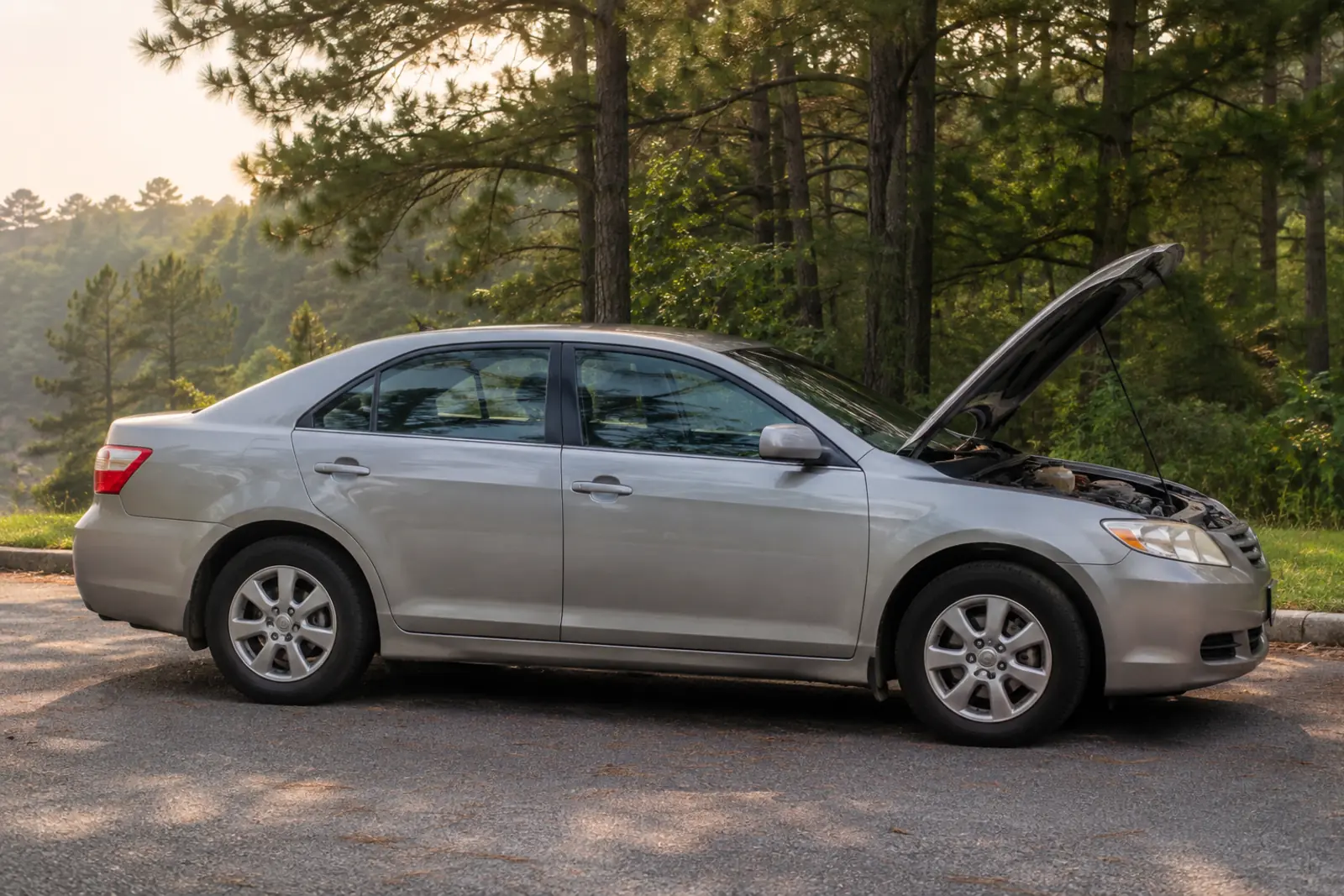
If your car starts to overheat in traffic, turn off the air conditioning, turn the heater on full hot with the fan on high to pull heat away from the engine, and get out of the travel lanes as soon as it is safe. If the gauge reaches the red zone, a warning light comes on or you see steam, pull over, shut the engine off and let it cool. Never open the radiator cap or the coolant reservoir cap on a hot engine; the coolant is under pressure and can cause severe burns. Driving on with an overheating engine can warp the cylinder head or blow the head gasket, turning a modest repair into a very expensive one.
What to do when your car is overheating: step by step
- Turn off the AC. It adds load to the engine and heat to the condenser in front of the radiator.
- Turn the heater to full hot and the fan to high. The heater core acts as a small extra radiator. It will be uncomfortable, but it helps.
- Ease off. In stop-and-go traffic, leave a gap rather than creeping bumper to bumper, which keeps the engine working with little airflow.
- Get to a safe spot. An exit, a parking lot or a wide shoulder well away from moving traffic. On an interstate, follow the safety steps in the guide to breaking down on an Atlanta interstate.
- Shut the engine off if the gauge is in the red or steam is coming from under the hood.
- Wait. Let the engine cool for at least 30 minutes, often longer. Pop the hood from inside to help heat escape, but do not touch the radiator, hoses or caps.
- Look without touching. Check for coolant under the car, a burst hose, a missing belt or an obviously low reservoir.
- Add coolant only when cool. Once the engine is cool to the touch, slowly open the reservoir cap with a rag over it, and top up with the coolant type specified in the owner's manual. In an emergency, plain water can get you to a repair, but have the mixture corrected afterward.
- Decide whether to drive. If the temperature climbs again quickly, do not keep going. A tow or an on-site repair costs less than an engine.
Why you should never open a hot radiator cap
The cooling system is sealed and pressurized on purpose. According to Wikipedia's article on engine radiators, the cap contains a calibrated relief valve, and the pressure it holds typically ranges from 4 to 30 psi depending on the vehicle, with about 15 psi common on modern cars. Raising the pressure raises the temperature at which coolant boils. Opening a hot cap drops that pressure suddenly, so the coolant can flash into steam and eject scalding liquid from the filler. Wait until the engine is cool to the touch, then turn the cap slowly with a thick rag over it.
Car overheating when idle or in traffic
If the gauge climbs at a stoplight or in gridlock but settles when you drive at highway speed, suspect airflow. At speed, air is forced through the radiator; at idle the engine depends entirely on the electric cooling fan. A failed fan motor, a bad fan relay or fuse, or a radiator blocked with debris or internal scale are the usual culprits. A weak air conditioner at idle often points to the same fan problem. Until it is repaired, keep the AC off in traffic and run the heater and fan when the gauge rises.
Car overheating while driving at speed
Overheating at steady highway speed, when airflow is plentiful, usually means coolant is not circulating or has been lost. The likely causes are a thermostat stuck closed, a failing water pump, a burst hose or leak that has emptied the system, a slipping belt on cars with a belt-driven pump, or combustion gases entering the coolant through a damaged head gasket. Because the problem is not airflow, slowing down will not fix it. Take the next exit or safe shoulder, shut the engine off and check as described above.
Car overheating but has coolant: what else can be wrong
A full reservoir does not prove the system is working. Coolant can be present and still not move or not shed heat. Check these in order:
- Thermostat stuck closed. The engine heats up quickly after startup while the upper radiator hose stays cool.
- Water pump not circulating. A worn or loose impeller, a leaking seal or a failed drive can leave the coolant standing still. Look for leaks or noise at the front of the engine.
- Air trapped in the system. After a coolant change or repair, air pockets can block flow past the thermostat or sensor. Wikipedia's article on head gaskets notes that gas from a leaking gasket can form air pockets that hold the thermostat closed and push coolant out into the overflow tank.
- Cooling fan not running. Overheating at idle with normal highway temperatures.
- Clogged radiator. Gradual overheating under load or in heat, even with coolant at the correct level.
- Weak radiator cap. A cap that no longer holds pressure lets coolant boil at a lower temperature and escape.
- Head gasket leak. The same Wikipedia article lists foam in the coolant expansion tank and a milky, mayonnaise-like substance in the oil as possible signs, though it says the oil symptom alone is not conclusive. A compression test, leak-down test or chemical test for combustion gases in the coolant is used to confirm it.
If the level is full and the car still runs hot, stop driving it and have the system pressure tested rather than topping it up repeatedly.
Common causes
| Cause | Clues |
|---|---|
| Low coolant from a leak | Puddle under the car, sweet smell, low reservoir, crusty residue at hoses or the radiator |
| Failed electric cooling fan | Overheats at idle or in traffic, normal at highway speed; AC also weak at idle |
| Stuck thermostat | Temperature rises quickly after startup; upper radiator hose may stay cool while the engine is hot |
| Water pump failure | Leak or noise from the front of the engine, overheating at all speeds |
| Clogged or damaged radiator | Gradual overheating, especially under load or in heat |
| Broken or slipping belt | Squeal, battery light and overheating together on belt-driven pump systems |
| Faulty radiator or reservoir cap | Coolant loss without an obvious leak, boiling over |
| Head gasket failure | White exhaust smoke with a sweet smell, bubbles in the reservoir, coolant loss with no visible leak, milky oil |
Why heat and traffic make it worse
A cooling system sheds heat through the radiator, and it depends on airflow. On a hot afternoon in slow traffic, the air passing through the radiator is already hot and there is very little of it, so the system relies on the electric fans. The air conditioning condenser sits in front of the radiator and adds its own heat. A system that is slightly weak, with a tired fan, a partly clogged radiator or coolant that is a little low, can cope on a mild day and fail in summer gridlock. That is why overheating calls cluster in the hottest months. Heat also causes other summer breakdowns; the guide to car battery problems in Atlanta heat covers the most common one.
Reading the warning signs early
- The temperature gauge sits higher than usual, even if it has not reached red.
- The AC turns warm at idle; the same fan problem often affects both.
- A sweet, syrupy smell after driving, a sign of coolant leaking onto hot parts.
- Coolant reservoir level dropping between checks.
- Steam or vapor from under the hood after a drive.
Some cars do not have a traditional gauge and only show a warning light, which comes on late. If your car has only a light, take it seriously the moment it appears.
Coolant leak repair cost and other cooling repairs
What a coolant leak costs depends on where it is. A split hose is among the cheaper fixes; a leaking radiator or water pump costs more; coolant lost through a failed head gasket is the most expensive. The table gives rough ranges by repair.
| Repair | Typical range (verify) | Driveway job? |
|---|---|---|
| Radiator hose replacement | About $150 to $400 | Often |
| Thermostat replacement | About $150 to $450 | Often, depending on location |
| Cooling fan or fan relay | About $200 to $800 | Often |
| Radiator replacement | About $400 to $1,200 | Sometimes |
| Water pump replacement | About $400 to $1,200 or more | Depends; some are driven by the timing belt |
| Head gasket repair | Often $1,500 to $3,500 or more | Usually a shop job |
Ranges are for orientation only and vary by vehicle. Diagnosis normally includes a pressure test of the cooling system to find leaks and, if a head gasket is suspected, a combustion gas test. The comparison of mobile and shop repairs explains which jobs suit a driveway, and the checklist on how to choose a mobile mechanic in Atlanta lists what to ask before agreeing to a repair. Get the diagnosis and price in writing, and ask which part is leaking before approving a cooling repair.
Prevention
- Check the coolant reservoir level monthly with the engine cold.
- Follow the coolant change interval in your owner's manual and use the specified type. Mixing incompatible coolants can cause problems. Most coolants are mixed with water, commonly about 1:1, which Wikipedia's article on engine coolant gives as protection to roughly -34 °F; follow the mix your manual specifies.
- Have hoses and belts inspected at oil changes; replace any that are cracked, swollen or soft.
- Keep the radiator and condenser fins clear of debris.
- Pay attention to a warm AC at idle; it is often the first hint of a fan problem.
A dashboard warning that appears along with overheating may also set a trouble code. The check engine light guide explains how codes are read and why they are a starting point. If your air conditioning is weak as well, see why a car AC stops blowing cold.
Frequently Asked Questions
Can I drive a car that is overheating?
Only briefly to reach a safe spot. Continuing to drive with the gauge in the red can warp the cylinder head or damage the head gasket. Stop, shut the engine off and let it cool.
Why does turning on the heater help an overheating engine?
The heater core is a small radiator that uses engine coolant. Running the heater on full hot with the fan on high moves some extra heat out of the engine and into the cabin.
How long should I wait before opening the radiator cap?
Wait until the engine is cool to the touch, usually at least 30 minutes and often longer. Then open the cap slowly with a rag over it. Opening it hot can spray scalding coolant.
Can I use water instead of coolant?
In an emergency, water can get you to a repair. Coolant also protects against corrosion and raises the boiling point, so have the system drained and refilled with the correct mixture afterward.
Why does my car overheat only in traffic?
At low speed the engine relies on the electric cooling fan for airflow. A failed fan, a bad fan relay or a blocked radiator commonly causes overheating at idle while highway driving stays normal.
Why is my car overheating when the coolant is full?
A full reservoir only shows the level, not whether coolant is circulating. A stuck thermostat, failing water pump, trapped air, dead fan, clogged radiator, weak cap or head gasket leak can all cause overheating with a full tank. Stop driving it and have the cooling system pressure tested.
How much does it cost to fix a coolant leak?
It depends on the source. As a rough guide, a hose is often about $150 to $400, a radiator about $400 to $1,200 and a head gasket often $1,500 to $3,500 or more, with prices varying by vehicle and shop. A pressure test locates the leak before parts are replaced.